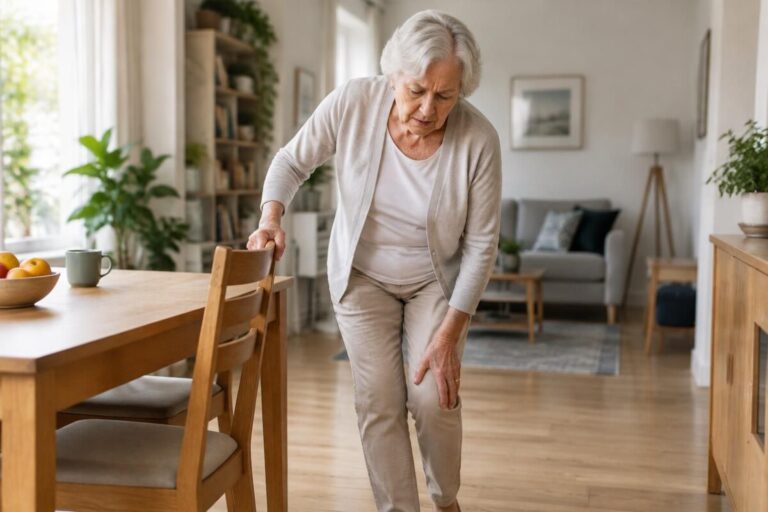
Senior mobility: 5 simple exercises to stay mobile
Hi, it’s Livia. To maintain your mobility, combine gentle seated and standing movements with a stable support, while staying within your abilities. Here are five exercises to adapt after age 70: ankles, knees, marching in place, torso and heels. They complement walking, without promising to eliminate all risk of falling.
Do this now
- Use a stable chair for support and to keep your movements safe.
- Make ankle circles to loosen the joints in your feet.
- Do seated knee extensions to strengthen your thighs.
- Do standing knee raises, engaging your abdomen for balance.
- Try gentle torso rotations to take care of your back.
Learn why getting up from a chair is crucial for preventing falls and find out how to respond to a warning sign in your mobility.
Set up a sturdy chair with no wheels on a clear floor, and sit with your feet flat on the floor. If you have been inactive for a long time, have fallen recently, or have a condition that limits your movements, ask for advice before starting. Stop if you experience unusual pain, dizziness or abnormal shortness of breath.
Why mobility declines after age 70 and what you can do about it
Inactivity, muscle weakness, pain or balance problems can limit mobility. Age alone does not explain every new difficulty. Adapted exercises can help; a rapid decline or worsening discomfort warrants an assessment.
5 simple exercises to stay mobile
- Seated ankle circles – lift one foot slightly and draw a few small circles without forcing the movement, then switch sides.
- Seated knee extension – gently straighten one leg as far as is comfortable, then place your foot back down. Alternate sides without holding your breath.
- Marching in place with support – hold on to a fixed surface or the back of a stable chair and alternately lift your feet a few inches. Stay seated if you feel unsteady standing.
- Gentle seated torso rotation – with your feet on the floor, gently turn your shoulders to each side, without sudden movements or pain.
- Supported heel raises – keep both hands on a stable support, slowly raise your heels, then lower them. Start with a few comfortable repetitions.
Practical guide: improve your mobility in 3 easy steps
| Step | Practical action | Safety tip |
|---|---|---|
| Step 1 | Start with gentle stretches to loosen your joints | Choose a stable support and do not push past the point of pain |
| Step 2 | Add simple muscle-strengthening exercises, such as knee extensions | Control your movements and keep your back straight |
| Step 3 | Work on your balance with adapted movements and a fixed support | Stay close to a support and progress gradually |
How can you make progress without putting yourself at risk?
Start with a short set, taking a break between movements. Increase gradually only if you can maintain good control. As a general guideline, work on strength, balance and flexibility at least two days a week, with regular light activity on the other days; your program should be adapted to your situation.
Maintaining balance and preventing falls: a winning combination
Strength training and balance exercises can help prevent falls, alongside adapting your home, having your vision checked and using assistive devices if needed. Do not stop using a cane or walker to test your progress. If you are afraid of falling, a physical therapist can help you choose the right movements and supports.
What tangible benefits can you expect from these simple exercises?
- Improved flexibility in the joints, which reduces stiffness.
- Muscle strengthening to support everyday movements.
- Improved walking thanks to better coordination.
- Reduced risk of falling by maintaining balance.
- Greater independence and confidence when getting around.
Simple exercises to do at home to preserve your mobility
A short routine can be a good start, but it is not a one-size-fits-all program. For illustrated movements, see the NHS strengthening exercises and its balance advice. The duration and progression depend on what you are able to do.
Why does mobility decline after age 70?
Mobility often declines because of muscle aging (sarcopenia), reduced joint flexibility and decreased physical activity, making movements more difficult and sometimes less safe.
What simple exercises can improve mobility?
Movements such as ankle circles, knee extensions, knee raises, torso rotations and heel raises help strengthen muscles, improve flexibility and maintain balance.
Can you start exercising again after a period of inactivity?
Yes, by starting gently, with exercises suited to your level and progressing regularly. It is best to avoid sudden movements and use secure supports.
How can you prevent the risk of falling?
By combining muscle-strengthening exercises with regular balance practice. Maintaining stability in the torso and lower limbs is essential.
Do you need guidance to do these exercises?
If you have fallen, are in pain, have an illness or experience significant difficulty, start by seeking advice from a doctor or physical therapist. A qualified adapted physical activity professional can then help you follow a program suited to your abilities.
Thank you for your interest; Livia